
Explore Machine Learning
Machine Learning (ML) is a dynamic subfield of Artificial Intelligence (AI) focused on building systems that can learn from, and make decisions based on, data. Unlike traditional software engineering, where developers write explicit, rule-based instructions to solve a problem, machine learning allows computers to analyze massive datasets, identify underlying patterns, and improve their performance autonomously over time.
8
Courses
14
Learners
Introduction to Machine Learning
Machine Learning (ML) is a dynamic subfield of Artificial Intelligence (AI) focused on building systems that can learn from, and make decisions based on, data. Unlike traditional software engineering, where developers write explicit, rule-based instructions to solve a problem, machine learning allows computers to analyze massive datasets, identify underlying patterns, and improve their performance autonomously over time.
In essence, traditional programming takes rules and data to produce answers. Machine learning reverses this paradigm: it takes data and answers to discover the underlying rules.
The Machine Learning Lifecycle
Developing a robust machine learning model is an iterative process that extends far beyond writing algorithmic code. The standard lifecycle consists of several critical phases:
- Data Collection: Gathering high-quality, relevant data from various sources such as databases, APIs, sensors, or web scraping.
- Data Preprocessing & Cleaning: Handling missing values, removing duplicates, filtering out noise, and normalizing data to ensure consistency.
- Feature Engineering: Selecting, transforming, and combining raw variables into distinct features that help the learning algorithm perform more effectively.
- Model Selection & Training: Choosing the appropriate algorithm (e.g., Random Forest, Neural Network) and feeding it the training data so it can learn the mathematical relationships within the dataset.
- Evaluation: Testing the model's performance on a separate, unseen dataset (validation/test set) using metrics such as accuracy, precision, recall, and F1-score.
- Deployment: Integrating the trained model into a production environment where it can process real-time data and deliver actionable insights.
- Monitoring & Maintenance: Continuously tracking the model's performance in the wild to detect "data drift" (changes in real-world data patterns) and retraining the model as necessary.
Core Paradigms of Machine Learning
Machine learning algorithms are generally categorized into four primary learning paradigms, depending on the nature of the data and the learning feedback loop.
Supervised Learning
In supervised learning, the model is trained on a labeled dataset, meaning every training example is paired with its correct output label. The goal is for the model to learn a mapping function from inputs to outputs.
- Regression: Used when the target variable is continuous (e.g., predicting house prices based on square footage, or forecasting stock market trends).
- Classification: Used when the target variable is categorical (e.g., classifying an email as "Spam" or "Not Spam", or diagnosing whether a medical image shows a benign or malignant tumor).
Unsupervised Learning
Unsupervised learning deals with unlabeled data. The algorithm must explore the input data to find hidden structures, patterns, or groupings without any human guidance.
- Clustering: Grouping similar data points together (e.g., segmenting customers into distinct purchasing personas for targeted marketing).
- Dimensionality Reduction: Simplifying datasets with hundreds of variables down to their most essential components (e.g., Principal Component Analysis) without losing critical information.
Semi-Supervised Learning
This paradigm sits between supervised and unsupervised learning. It utilizes a small amount of labeled data combined with a large pool of unlabeled data. This is highly practical in industries where labeling data is expensive, time-consuming, or requires rare human expertise (such as medical imaging analysis).
Reinforcement Learning (RL)
Inspired by behavioral psychology, reinforcement learning involves an autonomous agent that learns to make decisions by interacting with an environment. The agent performs actions and receives feedback in the form of rewards or penalties. Over time, the agent's goal is to maximize its cumulative reward (e.g., training autonomous vehicles, optimizing robotic arms, or mastering complex games like Chess and Go).
Key Machine Learning Algorithms
A wide variety of mathematical models power machine learning applications. Some of the most widely used include:
- Linear & Logistic Regression: The foundational statistical models used for predicting continuous values and binary classifications, respectively.
- Decision Trees: Flowchart-like structures that split data based on feature values, making them highly interpretable.
- Random Forests & Gradient Boosting: Ensemble methods that combine the predictions of multiple decision trees to improve accuracy and reduce overfitting.
- Support Vector Machines (SVM): Algorithms that find the optimal boundary (hyperplane) to separate different classes in high-dimensional space.
- Neural Networks & Deep Learning: Multi-layered computational networks inspired by the human brain. Deep learning excels at processing unstructured data like images, audio, and natural language.
Real-World Applications
Machine learning has transitioned from academic research to the backbone of modern global industries:
- Healthcare: Powering early cancer detection through computer vision, predicting patient readmission rates, and accelerating molecular discovery for new pharmaceuticals.
- Finance: Detecting fraudulent credit card transactions in real-time, automating credit scoring, and driving high-frequency algorithmic trading.
- Natural Language Processing (NLP): Enabling virtual assistants (like Siri and Alexa), real-time language translation, sentiment analysis, and generative AI models (like ChatGPT).
- Autonomous Systems: Allowing self-driving cars to perceive their surroundings, plan routes, and safely navigate complex traffic environments.
- E-Commerce & Entertainment: Driving the highly personalized recommendation engines of platforms like Netflix, Spotify, and Amazon.
Challenges and Ethical Considerations
Despite its immense potential, machine learning faces significant technical and ethical hurdles:
- Bias and Fairness: If the historical data used to train a model contains human biases, the model will learn, codify, and scale those biases. This is a major concern in hiring algorithms, facial recognition, and predictive policing.
- The "Black Box" Problem: Deep learning models are incredibly complex, making it difficult to understand why they made a specific decision. This lack of interpretability is a barrier in high-stakes fields like medicine and law.
- Data Privacy: Training powerful models requires vast amounts of data, raising concerns about how personal user information is collected, stored, and utilized.
- Environmental Impact: Training massive state-of-the-art models (especially large language models) requires immense computational power, leading to a substantial carbon footprint.
Topic Overview
- 8 Courses available
- 14 Active learners
Featured Courses
Top picks hand-selected by our team for Machine Learning.
All Machine Learning Courses
Browse all courses in Machine Learning.

Deploying Production-Ready Machine Learning APIs with FastAPI and Docker
Master the deployment of robust machine learning models as high-performance APIs. Learn FastAPI, Pydantic data validation, Docker containerization, and AWS EC2 deployment to build production-ready ML microservices from scratch.
LLM App Development: Building Powered Applications with LangChain
Master the fundamentals of LangChain to build LLM-powered applications. This beginner-friendly course guides you through prompt templates, chains, agents, conversational memory, and document loaders using Python and OpenAI.

Visualizing Eigenvalues and Eigenvectors: The Essence of Linear Algebra
Master the visual intuition behind eigenvectors and eigenvalues. Learn how linear transformations stretch space, how to calculate eigenvalues, and why an eigenbasis is crucial for simplifying complex computations in physics, machine learning, and high-dimensional vector databases.

Applied Linear Algebra: Real-World Applications of Matrices
Explore the practical power of matrices and linear algebra. Learn how these mathematical tools drive computer graphics, Google's PageRank algorithm, physics simulations, and modern data science.

Deep Dive into LLMs: Building and Training GPT Models from Scratch
Master the inner workings of Large Language Models by coding a complete GPT-style architecture from scratch. Learn tokenization, multi-head attention, pretraining, and supervised fine-tuning using PyTorch and Python. Build, train, and align your own deep learning models.

Mastering AWS Cloud Foundations: CLF-C02 Certification Prep
Master core AWS services, cloud security, architecture, and billing models to ace the AWS Certified Cloud Practitioner (CLF-C02) exam. This comprehensive, structured guide provides foundational cloud knowledge, practical service overviews, and key exam preparation strategies for success.

Python Programming Masterclass: From Basics to Machine Learning and Web Development
Master Python programming from scratch. Go from fundamental syntax to building real-world projects in automation, machine learning with scikit-learn, and web development with Django.
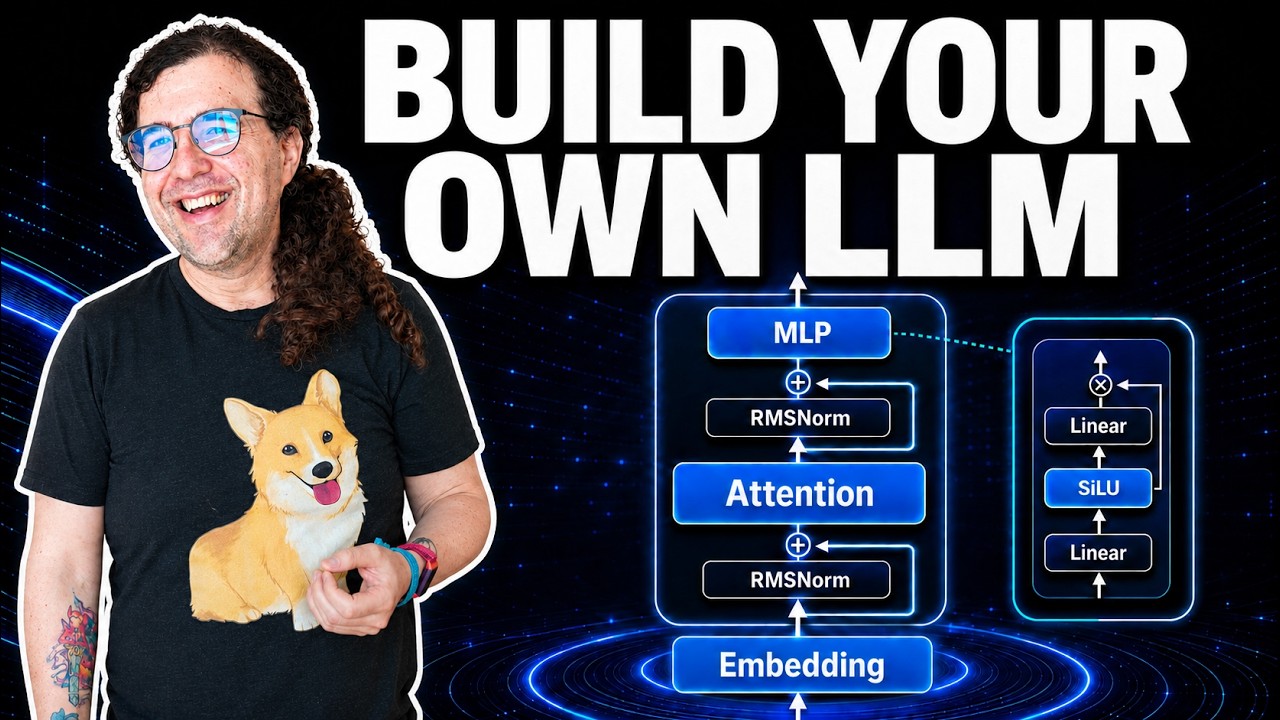
Architecting Large Language Models from Scratch: From Perceptrons to Post-Training
Master the inner workings of LLMs by building a GPT-2-style transformer from scratch. Learn neural network fundamentals, GPU optimization, attention mechanisms, pre-training pipelines, instruction tuning, and policy optimization using PyTorch.
Popular Channels
Discover the best YouTube creators in this space.


Learn from the Best
Top educators from YouTube, all in one place.

Caleb Curry
@codebreakthroughProgramming Made Fun and Simple Business inquiries: calebcurry@kernelmanagement.com High quality tutorials that are fun, educational, and easy to follow. Teaching programming is my passion! I find joy in making complex material easy to understand. As an Amazon Associate I earn from qualifying purchases.

Coder Army
@coderarmy9Hi Coder, We are on a mission to create Best Coder in our Country and for that we are putting best content for Students. I am Rohit Negi who graduated from IIT Guwahati and got Highest Placement in India in 2021. I got AIR 202 in GATE CSE in 2020. Brand Collaboration: rohitnegi.business9@gmail.com

freeCodeCamp.org
@freecodecampLearn math, programming, and computer science for free. A 501(c)(3) tax-exempt charity. We also run a free learning interactive platform at freecodecamp.org
Didn't find what you were looking for?
Explore other topics or browse all courses to find exactly what you're looking for.